Plenty of frying pans. But not the one they need
Emails, calls and conversations after delivery reveal what an online shop is missing. A story about choosing products and understanding why people buy.
Imagine you run an online cookware shop. You have added new frying pans to the website: photographs, sizes, prices and stock levels. The catalogue is bigger.
An email arrives:
Hello. Do you have a small frying pan? I just need to fry an egg in the morning. I looked on the website, but they’re all big.
You open the category. There are plenty of models, but the right size really is missing.
You could reply ‘sorry, we don’t’ and close the email. But the customer has already told you what she could not find. Now you can find out more.

Keep the conversation going
You reply:
Hello! What do you use at the moment? What’s awkward about it? And could you tell me what sort of hob you have, so I can check suitable options?
From the first email, you already know why she wants a small frying pan: to make a small breakfast. The follow-up questions will help you find options. Write down her answers; they will be useful when choosing models from your supplier.
Save the email with the request for a small frying pan. Look for earlier questions about the same thing in emails, chats and conversations with your team. Then check the supplier’s options: sizes, intended use, compatibility, price and order terms.
In our story, you find models that meet those conditions and send links with dimensions and delivery times. The customer can compare them at home. One conversation is not a reason to buy a large batch, but you now know which option is worth testing.
If you add more frying-pan sizes to the catalogue, the range gains depth: you are widening the choice within an existing category.
Call after delivery and let the person talk
Suppose the customer chose a model and the order has been delivered. A few days later, you call:
— Hello, it’s the cookware shop. You ordered a small frying pan from us. Have you got a couple of minutes? I just wanted to check everything was all right and whether you’ve had a chance to use it.
If the person has tried their purchase, ask:
— How are you finding it? What do you use it for most?

Let them finish. There is no need to move to the next question as soon as they say ‘everything’s fine’. Their story may contain details the order does not.
When they finish, you can ask:
— Why did you go for this one? Were you looking at any others?
— And what made you order from us?
Write the answers in their words. Why they chose the product helps you understand what to show on its page. Why they chose the shop tells you what they valued about your service, such as help choosing or delivery options.
Speak to several buyers of the same model. Someone may tell a completely different story; someone else may mention a difficulty you have not noticed yet.
At the end of the call, you can ask for a review:
— Thanks for telling me. If you have a minute, would you leave a review on the website about how you use it and what you found useful or awkward? Can I send you the link?
You are giving the person your attention and a chance to share their experience. That may leave a good impression of the shop. What sort of review they write is up to them. If something is wrong with the order, help resolve that first.
An incoming call can suggest a new category too
A man calls the online shop:
— Do you sell cooking pots? I couldn’t find any on the website.
— Not yet, but we’re thinking of getting some in. Were you after a large one or a small one?
— A bigger one, really.
— What do you usually cook in it?
— Mostly soup. The kids are growing. I make a pot and it’s all gone by the evening. I’d like some left for tomorrow as well.
— How many of you are there at home?
— Four.
— Do you remember how many litres your old pot holds?
— I don’t. I’d have to check.
You already have a task: soup for four, with some left for the next day. You do not yet know the old pot’s capacity; that needs checking.
— What sort of hob have you got: gas, a standard electric one or induction?
— Induction. We only changed it recently.
— Are you looking for one pot, or would you consider a set?
— No, just the one. The others are fine.
— Apart from the size, is anything else awkward about the old one?
— The handles are tiny. You can’t get a proper grip with an oven glove, especially when it’s full. I’d like to be able to hold it properly on both sides.
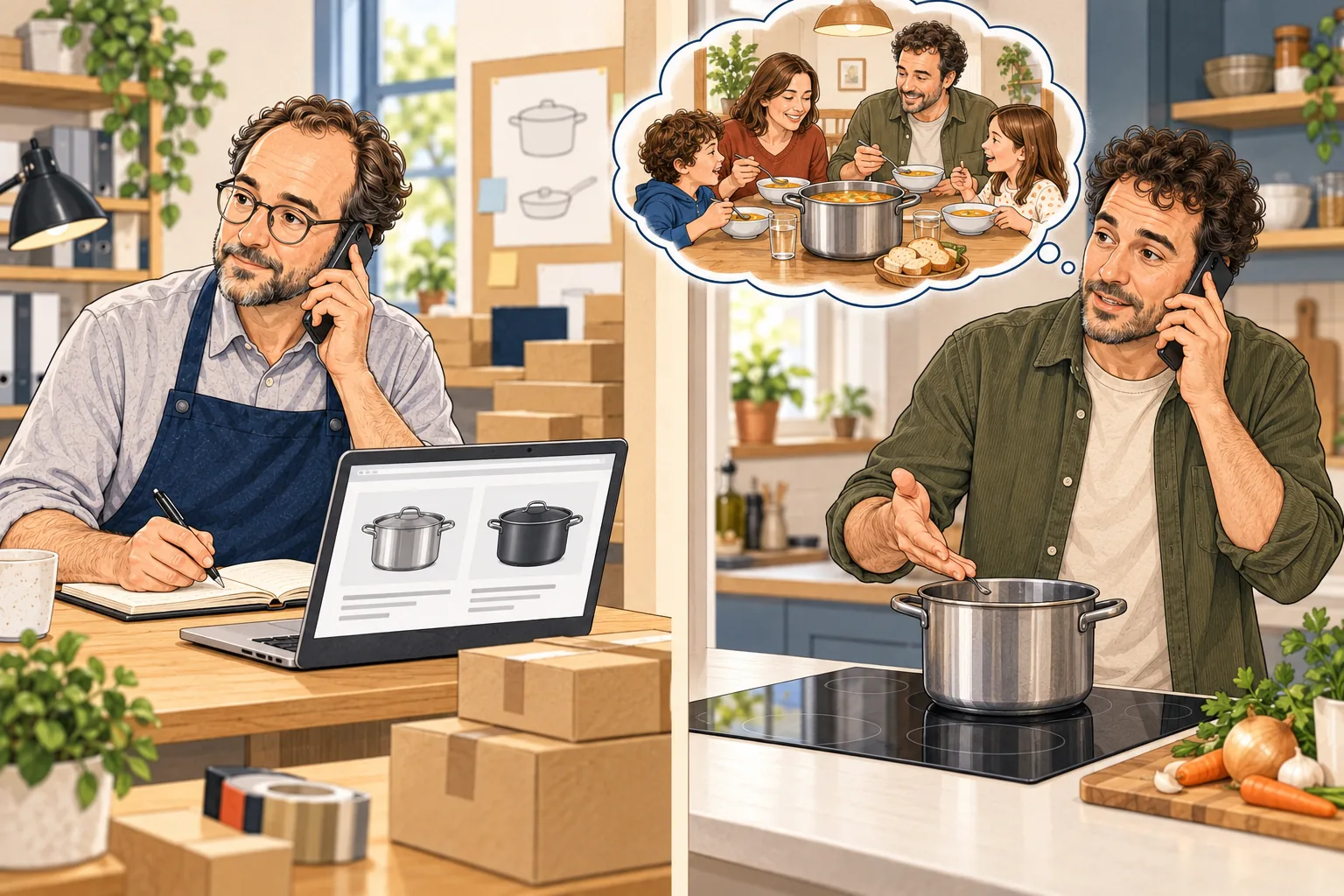
A few follow-up questions have told you what they cook, which hob they have, why they are replacing the pot and what matters about the handles.
Now agree on what happens next:
— Could you check how much the old one holds and send us a message? I’ll find some options from our supplier and send links with dimensions and prices. Would email be all right?
Instead of ‘someone asked about a cooking pot’, you now have specific buying requirements. You still need to check whether a model you find is compatible with the hob. And if you add cooking pots to the catalogue, you gain a new category: the range grows in breadth.
Keep emails and calls in one place
When enquiries are scattered around, it is easy to remember only the latest conversation. Keep a shared record for you and your team: what people wanted, why, what did not suit them about the available options and how the conversation ended. If there was an order, add its number so you can later match the story to the model bought.
Let’s see what that could look like after two weeks. The figures below are invented for our story:
People asked about a larger cooking pot five times, by phone, email or chat. That is a reason to look more closely at the category. But return to the conversations too: one person needs to cook for a family, another has changed their hob. The models that suit them may differ.
Choose options, find out the prices and supply terms, then offer them to the people who asked. Someone may already have bought elsewhere. Someone may only have been comparing prices. Five enquiries do not mean five future orders.
And keep two questions separate: ‘what are people looking for but not finding?’ and ‘why do they buy what we already have?’ Emails and incoming calls help reveal gaps. A conversation after delivery helps explain a choice already made. One channel does not replace the other.
Help the customer equip their kitchen
A call like this can tell you much more than how one order turned out:
— What else are you buying for the kitchen at the moment?
— Where do you usually buy it? Did you look with us, or go straight to another shop?
— Was there anything you couldn’t find with us?
Let the person tell their story. Perhaps they are setting up a kitchen after moving house. Or gradually replacing old cookware. Ask what they have already bought elsewhere and what they still plan to order. You will have specific products to consider adding to your range.
For example, someone buys a cooking pot from you for $50, but orders a ladle for $10 somewhere else. Why not offer it yourself? They are already choosing cookware for preparing food. Buying the utensil they need in the same order may be convenient.
If they buy both products, the total will be $60 rather than $50. The prices in this example are illustrative. The customer gets a useful addition, and the shop sells two products in one order.
You can gradually build a section of kitchen essentials: ladles, spatulas, special lids and other utensils. The main product gains less expensive additions. On the cooking pot’s page, show suitable items with separate prices and an option to add them to the basket. Check size and compatibility for lids.
Conversations shape the buying list: what people already buy, what they cannot find with you and what they go to other shops for. Start with repeated requests, check supplier terms and offer suitable additions. Then use your orders to see what people buy together and what they come back for later.
Where to start in your shop
Open recent emails and chat messages. Think about the questions people have called your team with. Choose several buyers of one model whose orders have been delivered and who have had time to use it. Ask why they chose it, how they use it and what else they buy for the kitchen.
Do not try to get a full specification from everyone. Start with one question and listen to the answer. The next useful question will usually come from what the person tells you.
When you have candidates to add, compare supplier terms: minimum order, lead time, purchase cost, how much you will have to invest in stock and how long that money could remain tied up in unsold items. A repeated request helps you choose what to test; it does not remove the need to work out the purchase costs.
Once the new item is available, watch whether people reach its page, what they ask and whether they order. If hardly anyone has seen the product, a lack of orders does not yet explain whether customers need it.
All of this can start with an ordinary ‘do you have…?’ email or a call after delivery. Let the person explain what they plan to do with the purchase. Their story may give you an idea for a new product, a better explanation for its page and a reason to come back to your shop.
Assortment Planning for Online Stores: What to Add and Keep
Decide what your store carries using Google Ads data. In our data, growing stores earned a bigger share of revenue from new products than declining stores.
Sell-Through Rate and Assortment KPIs: What to Track and How
See which products sold the stock you bought: sell-through rate on a worked example, plus ad-data KPIs that measure your catalogue, not just your orders.
A flask for Friday. New stock in two weeks
How to avoid running out of a popular product: a customer needs a flask by a deadline, and an online shop owner takes another look at stock.
How we increased an online store's sales 3-5x thanks to GetProfit
Product segmentation for Google Ads: how assortment analysis turned into five product groups by sales volume and a daily budget reallocation between them.
The new bag is not selling. Drop it or test again?
How to review a failed product test in an online shop: find what stops people choosing, test one possible cause and cap the next round of spending.
How the right taxonomy improves ad performance
Google Taxonomie: why product visibility, CTR and conversion rate all depend on getting the categories and attributes of your product feed right.