How effective assortment management lifted ROAS from 243% to 650%
Scaling e-shop sales through assortment analysis in Google Ads: the case of a cosmetics store.
- Do you have an e-shop with more than 400 items?
- Do you have advertising running in Google Ads?
- Are you getting at least 20 orders a month?
- Do you want to increase efficiency and revenue?
If that’s 4x “Yes” — read on. This case may be about your e-shop too.
One day I asked myself a simple question:
Why do some products work in advertising and others don’t — even though they are almost identical?
And that is exactly what led me to a fundamental realisation:
The key isn’t just campaign setup, but working with the assortment itself in advertising.
I started distributing budget according to the results of individual products and whole segments — such as categories, brands or specific groups of goods.
And that’s where the changes began.
We’ve prepared several examples from practice: how it works and everything we did.
I know what it’s like to read a case study and not understand what to do next.
That’s why we add important notes, so you understand the principle and can apply it in your own e-shop.
To the examples
Cosmetics e-shop (Czech Republic)
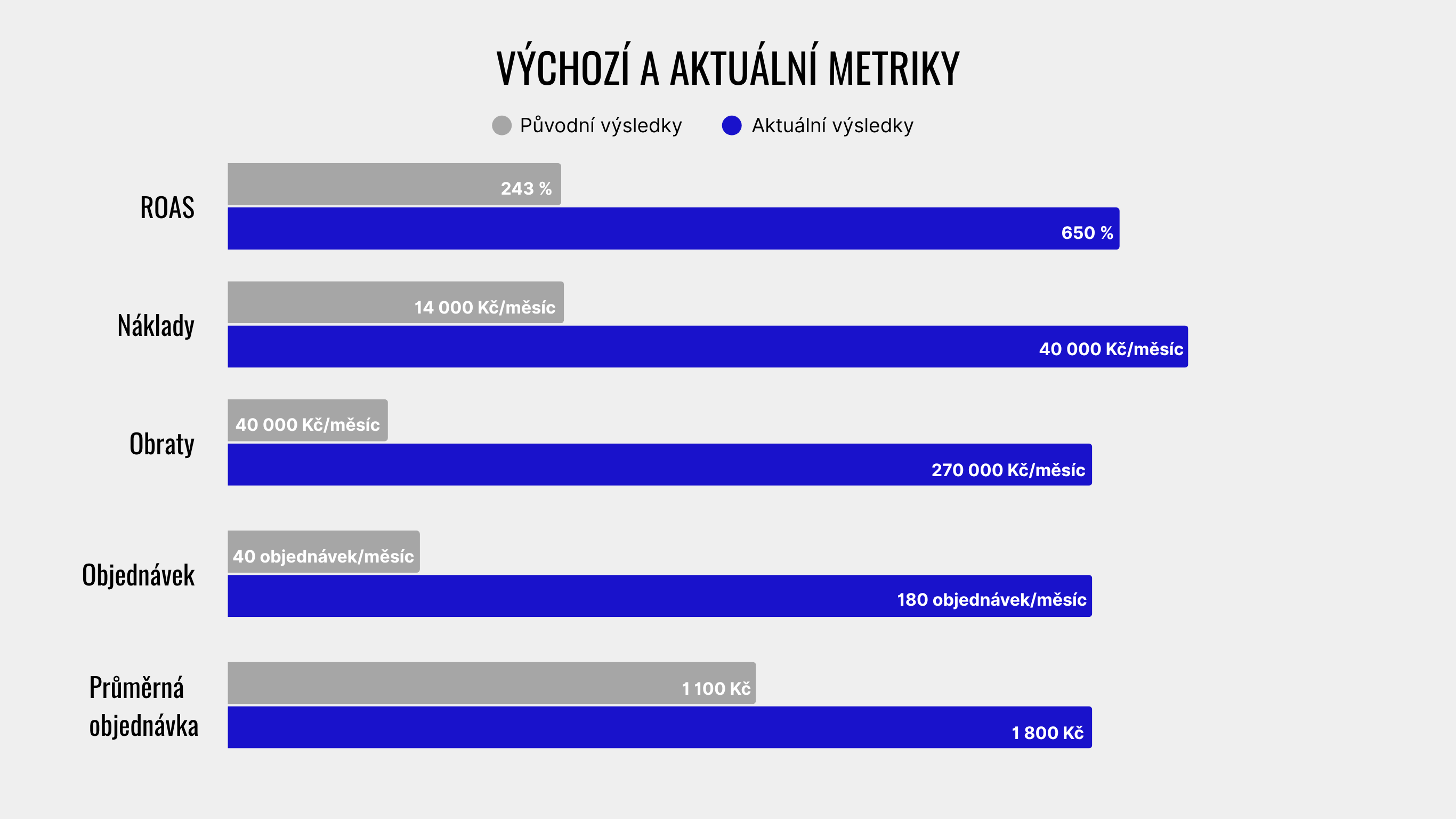
ROAS change: 243% > 650%
Monthly revenue change: 40,000 CZK > 270,000 CZK
- Category: Cosmetics
- Size: growth from 30–50 to 50–250 orders a month
- Assortment: 800+ SKUs
The results we achieved with Getprofit:
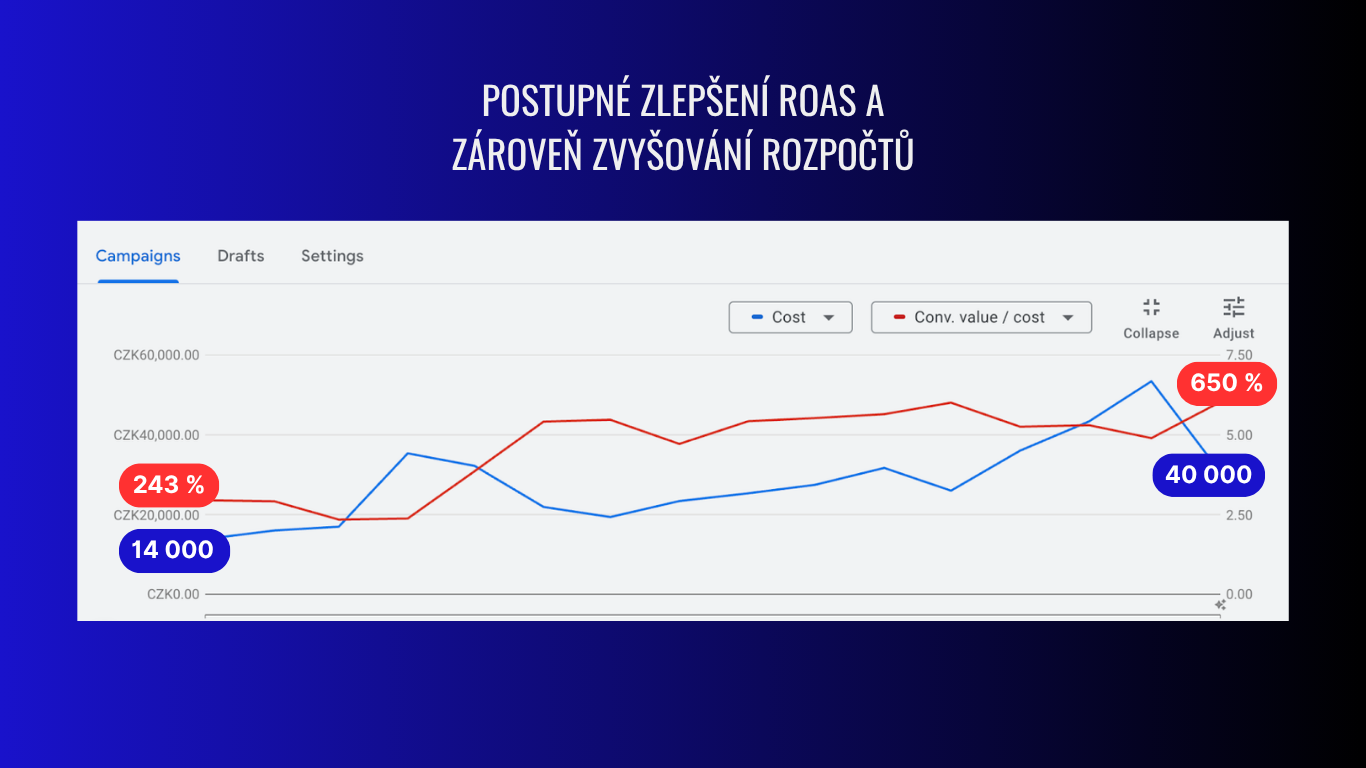
The chart shows well that a marked improvement in ROAS doesn’t necessarily mean a stagnant budget — quite the opposite.
Thanks to thoughtful work with campaigns and assortment, we managed not only to hold efficiency but at the same time to gradually increase the investment into advertising.
The result is growth from the original 14,000 CZK a month to 40,000 CZK at many times higher performance — ROAS rose from 243% to more than 650%.
This development confirms that properly structured advertising can be not only profitable but also scalable over the long run.
The results achieved were not merely the merit of campaign setup or strategy changes.
A large share of the success also belongs to the e-shop owner, who worked actively and systematically on improving his store.
The three most important areas we worked on together
- Working with the assortment
- Campaign structure in Google Ads
- Ongoing campaign optimisation
1. Working with the assortment
The assortment is the core of every retail business.
The better you manage it, the more stable and predictable the growth will be.
What we addressed specifically:
- Adding new products
- Limiting or removing weakly selling items
- Working with average order value (AOV)
New products
At the start the e-shop had roughly 400 products (SKUs).
That was too few, and on top of that it lacked well-known brands that would appeal to a broader audience.
“If you sell specific products (e.g. goods for a narrow target group), you need a wider assortment in order to widen your target group.
By widening the assortment you find certain market segments with less competition”
Example:
- You sell wine for the general public → 300–500 products may be enough
- You sell collector’s wines or gift editions → we recommend 2000+ SKUs
The e-shop owner took it to heart and started actively expanding the assortment.
Today he has over 800 SKUs and keeps adding new items.
“Watch the average price of newly added products. Higher price = higher AOV (average order).”
Removing what doesn’t deliver results.
The next important step was getting rid of products that don’t deliver results — or do, but only at first glance.
What we did:
- We replaced weakly selling segments with fresh and better targeted products
- We identified new bestsellers that raised the average order
- Products that had revenue but weren’t profitable we removed from the ad campaigns
“Before you remove anything, always add alternatives first.
Otherwise there’s a risk you’ll lose revenue, since you don’t know whether the new items sell”
Guide: Working with the assortment.
How to analyse assortment performance?
We recommend tracking the development across these segments:
- Brand
- Collection
- Category
- Size / volume (if you have standards)
- And similar
If you have enough data, you can combine them with each other.
For example: “brand A + autumn collection” or “body care category + 200 ml volume”.
Working with average order value (AOV)
Regular work on raising the average order brings an e-shop significant advantages:
- higher revenue
- higher budget efficiency
- and better campaign performance over time
“Raising AOV is one of the easiest routes to growth without having to immediately increase traffic or order volume”
Guide: How to increase the average order.
What do we mean by that?
Let’s look at a model example:
Starting scenario (current state):
- 50 orders a month
- Average order: 800 CZK
- Revenue: 40,000 CZK
- Cost-to-revenue ratio: 10% = 4,000 CZK
- Margin: 30% = 12,000 CZK
- Profit: 12,000 CZK – 4,000 CZK = 8,000 CZK
Scenario after raising AOV to 900 CZK:
- 50 orders a month
- Average order: 900 CZK
- Revenue: 45,000 CZK
- Cost-to-revenue ratio: 8.9% = 4,000 CZK
- Margin: 30% = 13,500 CZK
- Profit: 13,500 CZK – 4,000 CZK = 9,500 CZK
Profit rose by 1,500 CZK a month without any need to increase the budget.
But what if we hold the cost-to-revenue ratio at 10%?
If the cost ratio stays the same at a higher order value, the order volume grows at the same time.
That is:
Variant with increased revenue:
- 56 orders a month
- Average order: 900 CZK
- Revenue: 50,560 CZK
- Cost-to-revenue ratio: 10% = 5,050 CZK
- Margin: 30% = 15,170 CZK
- Profit: 15,170 CZK – 5,050 CZK = 10,120 CZK
Profit grew by 2,120 CZK, which represents an increase of 26.5% against the original scenario.
“Even small differences can add up quickly.
And the bigger the e-shop, the more pronounced the impact of every AOV increase.”
Guide: How to increase the average order.
What’s more — as soon as revenue grows, your negotiating position with suppliers often rises with it, or margins can be adjusted.
That’s why we recommend working constantly on raising the average order.
What we did specifically:
- We added new products with a higher selling price
- We removed inefficient items from the campaigns
- We changed the free shipping threshold from 700 CZK to 2,000 CZK. We do not recommend making such big changes without an initial analysis; we adjusted it purely on the basis of the average order value.
“Expanding the assortment has to be done gradually — ideally adding 50–200 new products a month. Too rapid an increase can negatively affect Google Ads algorithms”
Further steps the client is working on:
- Continues adding new products
- Creates product sets (this raises the average order)
- Is thinking about complementary products that customers already buy, but in other stores
2. Ad campaign structure in Google Ads
The client originally had only one campaign — Performance Max (PMax).
That doesn’t allow effective management of budget, performance or assortment in advertising.
For a new structure to deliver results, you need to analyse:
- Which product groups bring sales
- Which drain budgets
- What the efficiency of individual product groups is
- And other relevant metrics
+ EXTRA:
Analysis of the performance of every product in advertising.
The outcome is to segment the assortment into groups and create further ad campaigns.
“You can download a step-by-step guide to how we do the analysis here.”
Segmentation and splitting the assortment
Our work doesn’t end with splitting the assortment based on the analysis. We have our own algorithm that fully analyses the entire assortment and divides it into several segments by performance every day.
Based on this data we split the assortment into two ad campaigns:
- products that bring sales, and new arrivals (focused on revenue)
- products that have accumulated a certain volume of data but have no sales or are unprofitable, including items that have been in the offer for a long time on a small budget (focused on efficiency)
The result is an increase in advertising efficiency, as can be seen on the chart.
Limits of finer segmentation
Finer segmentation was not possible in this case, because there was too little data.
From our experience, a campaign needs at least 30 conversions in 30 days to be at least partly stable. Or, put differently, to run at a certain ROAS.
“You can test different product groups by creating several separate campaigns and assigning a budget to each of them. This approach, however, requires having sufficient financial resources available.
If you don’t have enough data yet, the main goal of this split is to test the potential of the individual groups.
Mind the number of items in a campaign — ideally 300 to 1000 SKUs per campaign”
Next step: splitting the campaign
After several months, once we had reached 100+ conversions a month, we analysed the assortment again and found it was time to split the original campaign no. 1 (bestsellers).
We had enough data by product group, but ROAS differed markedly — from 300% to 700%.
We were looking forward to this phase, because it allowed us to increase campaign efficiency and raise sales.
It is precisely for this phase that we have developed our own algorithm, which — based on the data obtained from Google Ads — helps to effectively split the assortment and build the structure of ad campaigns.
“There’s no need to split campaigns while performance keeps growing.
Splitting makes sense if you feel you’ve hit a ceiling and can’t break through it.
Or: you can’t raise budgets in Google Ads at the same or a similar ROAS / cost-to-revenue ratio”
Splitting the Bestsellers campaign
We split the Bestsellers campaign into:
- Product groups with ROAS above average (500+%)
- Product groups with ROAS below average (500-%)
The 2nd Chance campaign
We haven’t split this campaign yet, because it contains few conversions and splitting it doesn’t make sense.
This step is important, but without ongoing campaign optimisation the account can’t be stabilised.
3. Campaign optimisation
We tested various approaches to optimisation and found out what most often has a positive impact:
- Google recommends changing target ROAS by at most 20%, but practice shows it’s better to adjust ROAS by at most 10%;
- If a campaign isn’t meeting KPIs, it’s not advisable to immediately raise ROAS by 5–10%. On the contrary, it’s often more effective to lower it slightly and then, after some time, gradually raise it again;
- Increase the budget gradually — ideally by 10% every 4–5 days; a sudden doubling can slow performance down because of relearning.
Optimisation based on the efficiency of every single item
Using our algorithm we track performance, cost, number of conversions, clicks and impressions of every product and segment.
When a product drains budget but doesn’t deliver results, we lower its priority and limit its budget.
Conversely, products with good results we support and raise their priority, so that Google shows them more often.
This way we achieve even better results and don’t waste budget on what doesn’t sell or runs at a loss.
Results in Google Ads:
- ROAS: +267%
- Revenue: +285%
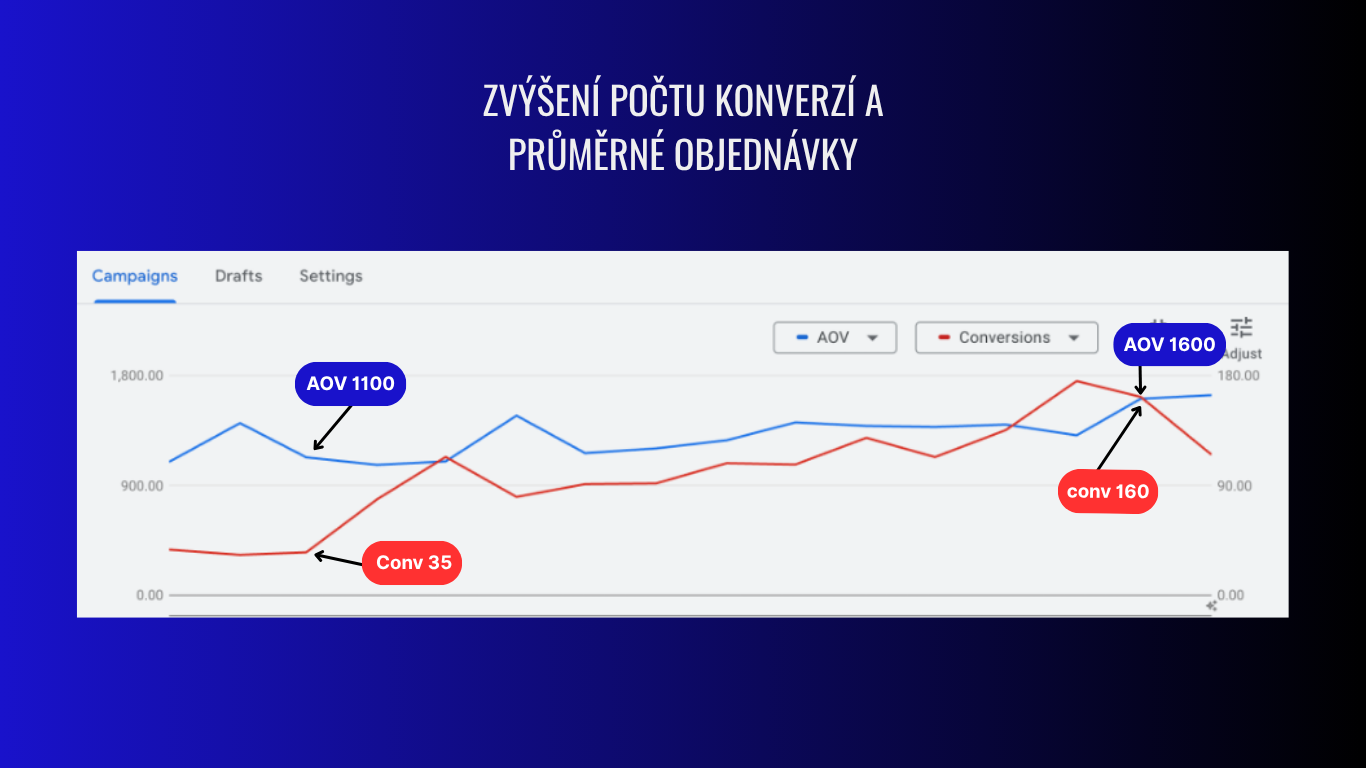
- Orders: +450%
- Average order: +163%
Conclusion and next steps
Success in online sales isn’t chance but the consequence of systematic work with data, correct campaign setup, work with the assortment and ongoing optimisation. As you saw in our example, even relatively small changes in strategy can have a marked impact on results.
If you want to increase your sales through Performance Max or Shopping campaigns, start right now — set up proper analytics, segment your assortment, and don’t forget to regularly optimise campaigns by performance.
In the following chapters we’ll look at examples of e-shops of various sizes and segments, where we’ll focus on specific metrics and strategies tailored to their needs.
What can you do now?
Using the guides we’ve created, analyse the state of your e-shop and gradually work on improving the assortment, the average order value and the ad campaigns.
Guides:
- How to set up analytics and verify it works? — (step by step, just repeat)
- How to increase the average order? — (main principles and examples)
- How to work with the assortment in an e-shop?
- Analysis of your items against the competition?
- Analysis of ad campaign performance.
From 80 to 240 orders in 4 months
A printer-cartridge e-shop case: fixing the analytics, splitting the assortment into five groups and rebuilding the campaign structure.
Nine stores joined in August 2025. A year later, five are still running — here are their numbers
Ukrainian cases without the showcase: we take everyone who joined in a single month a year ago. Four improved their return, one stopped advertising. With methodology and honest caveats.
ROAS from 111 % to 560 %: a home accessories e-shop
A small home-accessories e-shop case: splitting the assortment into five groups, two campaigns by performance and excluding products under 300 Kč.
How we burned 895.000+ Kč on Google Ads in an e-shop
How to find out where you're burning your Google Ads budget in your e-shop. A detailed guide.
Kids' goods e-shop — 14× more orders
A kids' goods e-shop case: 1000 SKUs in a single campaign, the assortment split into five groups, two campaigns and ROAS from 150 % to 450 %.
How we tripled an e-shop's revenue in 2 months
We described how our method multiplied an e-shop's revenue and at the same time improved the efficiency of its Google Shopping advertising.